
Alumni at Work
Alumni discuss their professional experiences
Below alumni relay their experience covering COVID-19. Alumni were on the frontlines, documenting the pandemic, while others were shaping how companies communicated in these unprecedented times.
Jim Cunningham ’77
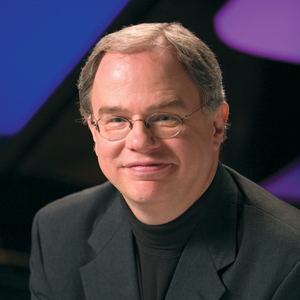 Jim Cunningham ’77 is WQED Morning Show host and Senior Executive Producer at WQED-FM in Pittsburgh.
“Fred Rogers H’69 told me on several occasions that he was delighted to be a part of the Thiel family, having received his first of more than 40 honorary degrees from the College. He wove all of his academic scarves and regalia into a quilt that hung on the wall in his office at 4802 Fifth Avenue in Pittsburgh. How quiet it is in his hallway now. What would he have thought of the pandemic? He’d have suggested you should “look for the helpers.” I spoke with his widow Joanne Rogers standing in the check-out aisle at Staples just one day before Governor Wolf shut down Pennsylvania to slow the spread of the disease. Joanne was there to buy some notecards, she’d just had her hair done and picked up a few groceries, still driving herself at age 92. A few days later she said the same to the Los Angeles Times. “Helpers,” she explained, are those individuals who—even at the height of global chaos—try to find a way to ease the burden for others. Doctors, nurses, grocery store cashiers and mail carriers. So it is with Thiel grads.
I interviewed Fred for WTGP when Fred visited campus to watch his Latrobe friend Arnold Palmer H’76 receive an honorary degree. I was an intern at WQED for Mr. Rogers Neighborhood helping guest Julia Child make Spaghetti Marco Polo for young viewers. Today we’re whipping up comfort food recipes and trying new skills in the kitchen while restaurants are closed.
When Professor of English Evelyn Baer arranged my internship in January 1974, I could never have guessed that after decades of broadcasting experiences, I’d be talking into a microphone from my dining room table speaking to WQED-FM listeners and Greenville listeners through the retransmission of the signal of WXTC formerly WTGP at the Pedas Center for Communications.
WQED’s staff of 60 were all working from home to discourage the spread of disease. The quality of the signal from my house is so high that no one knows I’m not at the edge of the CMU campus where the main studio is located. It was very odd to be one of a handful of employees that were allowed in the building to pick up mail as “essential life-enhancing service,” officially designated by the State of Pennsylvania. There is no doubt the educational core of PBS on WQED 13, teaching for children and life-long learning, and the healing power of great music on WQED radio are more important than ever. In the Wall Street Journal Elizabeth Bernstein, in her On Relationships column, writes “How to Be Grateful to Boost Mental Health and Cope With Stress: Listen to some relaxing music, spend some time in nature.
The arts have been hit hard by the pandemic. WQED broadcasts the concerts of the Pittsburgh Symphony Orchestra each week. No one knows when they will play again or when listeners will feel safe gathering in groups at concert halls. In late 2019, I was in Berlin as a WQED correspondent on the Pittsburgh Symphony’s European Tour. There I had coffee with Ken Nein ’76 who teaches English at the University of Applied Sciences Potsdam, where now all courses are online. Ken’s wife, Eva, works in her hospital’s children’s ward. Ken’s son, Lukas, works for the German Social Security Agency at home, as required. Everyone was wearing masks while shopping in Berlin even though some churches and schools were opening. Ken says “it’s still all rather spooky, like being in a very bad sci-fi B film.
Ken stays in touch with Benedictine monk and priest Brother Paul Shutt ’75, who preaches Sundays and teaches French, Latin, and Italian at St Vincent’s Archabbey in Latrobe. They often exchange political cartoons. A good sense of humor is essential during a pandemic.
Last November, when Manfred Honeck and the Pittsburgh Symphony played Bruckner’s Ninth Symphony at the Philharmonie, the home of the Berlin Philharmonic, I would never have dreamed the Berliners would gather there in a scaled-down version playing a concert with no audience and “social distancing” on the last day of April 2020.
I watched the online Sunday services of First Lutheran Church of Warren, Pa., where my Mom has sung in the choir since 1960. My Thiel classmate Rev. David Blank ’79 was the Pastor there for many years. I see Thiel grad Liana Carlson Reynolds ’76 often. She visits her Dad, retired music teacher Pete Carlson, who drives around town at age 93 always staying to hear organist Jack Hemink play the postlude. Pete and his family are irrepressibly cheerful.
Cardiologist and Thiel radio DJ Dr. Jim Sechler ’76 is treating his patients as part of his practice in Cleveland hospitals. Jim told me “it is a very strange world!! I wonder if it will ever be normal again!
My beloved English Prof and advisor Dr. Richard Schroeder tells me he is shocked at the state of affairs in our world. He has remained a constant in my life with advice, film, and book ideas calling the movies “Kino-tips” and sending dispatches from far-flung places of study.
For two summers, I mowed the lawn (badly) of Dr. James Bloomfield and Jan. He is digging in to his pile of books reading about Roosevelt in WWII and convergent evolution plus a book on Weimar era German art, while Jan is wading through Brooklyn The Once and Future City. Brooklyn, the epicenter of the COVID-19 crisis is where she was born. They remain cheerful with the knowledge of history that we will arrive on the other side in good shape.
I’m from a Thiel family. My brother Matt ’78, father, Jim Jr. ’53, mom, Carol, aunt Rosemary ‘53, uncle Bob Richard ‘53, and former Thiel Board member grandpa Dr. Rev. Elmer Ortner ’23, who married a Thiel student and Greenville resident grandma Dorothy Cooke. After a half-century in the pulpit, he preached for the first time at St. John’s Lutheran in Connellsville at age 74 choosing the sermon topic “On Being Positive.” He’d lived through countless offering plate crises, the Spanish Flu, and two world wars. I am grateful to have the time to connect with extended Thiel family, take walks in Point Breeze with my wife, Laurie, enjoying the spring flowers, dote on U of Michigan viola major Jim IV, and listen to the radio. Life may change dramatically and suddenly, but friends, family, the Lux Mundi, Verbum Dei of Thiel College will keep you going."
Michael Allen ’90
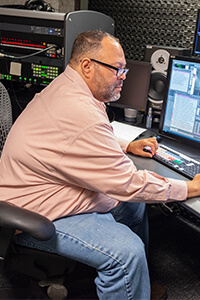 Michael Allen ’90 works in the ABC News Washington D.C. Bureau as a video editor.
“It was a strange time in the world. As I was driving into one of the largest cities in the Unites States, there were barely any cars on the road. As I walked into one of the largest news bureau in the world, it was deathly silent. I’ve worked in the media for more than 30 years. On every level, from local to network, I’ve covered some memorable moments in my career, but I have never seen anything like this. I thought 9/11 would be the most horrible thing I would see in my life but this was worse. I couldn’t shoot it with a camera or interview it, but it was effecting everyone in the world. I was essential personnel at my job so no matter how bad things got, I got to go and do my best to help inform the public to the facts of what was going on.
In the middle of all the hustle and bustle, I get an unexpected phone call from Mark Batt ’87, Director of the Thiel Fund, but more importantly a former classmate and friend. “Just checking in on you buddy.” It was the five minutes I needed to reset my mind. Thiel family checking on family, that’s what this College has always been for me, and always will be …FAMILY.
I don’t know what the future will bring with this disease, I have lost colleagues in this business to it, but I know I will keep working hard, telling stories, and informing the people with the best information I can give.
Stay safe, Tomcats.”
Meghan Speer ’02
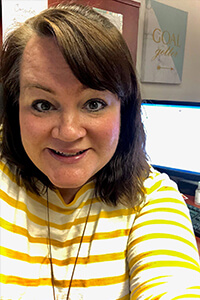 Meghan Speer ’02 is CEO of Marketing Support Network. She oversees the operations of the digital marketing team as well as the contact center, which has seen an increase in call volume during the COVID-19 crisis as well.
“No brand or organization wants to appear tone-deaf on social media. Not on a normal day and certainly not in a global pandemic. Situations changing by the moment take a toll on everyone but for those of us who work in digital marketing, trying to stay ahead of those changes is critical.
On a ‘normal’ week, my digital marketing team creates social media, email, and website content for 20 different companies and organizations. We have a marketing plan and a content calendar and typically work 5-10 days ahead, scheduling that content to go out at optimal times. As the COVID-19 crisis unfolded, all that content needed to be pulled back so that none of our clients fell into that tone-deaf category. We were changing content plans, sometimes every hour, to make sure that our clients’ audiences were always receiving the latest information when there were updates or encouraging words and some lighthearted humor when there were no updates. As the situation kept changing so did the plans, so the team was constantly on Zoom and messenger from their homes to coordinate their efforts. For our nonprofit clients it meant telling a new story about how they are helping in a crisis. For some local mom-and-pop businesses, it was making sure people knew how to support them and for national clients it was a renewed focus on community support over sales.
As CEO of Marketing Support Network, I oversee the operations of the digital marketing team as well as the contact center, which saw an increase in call volume during the COVID-19 crisis as well. Our company works with clients on their marketing and customer service strategies, both of which were critical in this time.”
Lauren (Whetzel) Siburkis ’10
 Lauren (Whetzel) Siburkis ’10 is an advanced communications representative at FirstEnergy in Akron, Ohio. She came to FirstEnergy in 2016, after working as a reporter and government publicist for many years.
“FirstEnergy operates a critical part of our country’s infrastructure and was committed to keeping the lights on as the nation addressed the coronavirus challenge. This health emergency made reliable electric service even more important as states rolled out business shutdowns and shelter-in-place orders that require people to stay in their homes to work and complete schooling.
As a media relations professional at FirstEnergy, I joined more than 7,000 employees who were working from home until it was safe to return to work. Fortunately, technology made this transition very smooth. Although I was not able to do in-person interviews with TV reporters, I set up a home studio that allowed me to do virtual on-air interviews with reporters using Skype and FaceTime. I was also able to participate in face-to-face meetings using Microsoft Teams.
From communicating internal updates with employees to sharing important information with customers, this health emergency reinforced the importance of a strong, unified communications team within a company or organization. While I scaled back on some of my traditional storytelling efforts pertaining to normal operational work, I was able to write and pitch stories that were relevant to this health pandemic. Examples include sharing stories on how to save energy while spending more time at home while quarantining, bill assistance programs that are available to customers who are unable to pay their bills during this time and contributions FirstEnergy has made to local food banks and United Way agencies.
One of the biggest challenges I faced during my time at home was handling a major storm in early April that caused more than 100,000 power outages in northeast Ohio. We certainly had more impatient and upset customers on social media since they had fully stocked refrigerators/freezers and relied on their power more than ever to work and do schooling from their homes. We also had quite a few media inquiries about whether the COVID-19 health emergency hindered our restoration efforts.
Another issue we ran into was customers wanting to approach our line crews in the field to ask questions, voice concerns or thank them. Not only was this unsafe to do under normal circumstances, with social distancing in effect due to this health emergency, it was a key message we needed to stress to customers to keep our essential workers safe in the field.”
Danielle Dwyer ’11
 Danielle Dwyer ’11 is a television sports journalist at KOKH Fox 25 in Oklahoma City, Okla. Oklahoma City is the 43rd-ranked television market in the country. She has been at the station for just short of a year now.
“As a TV journalist, this was a freeing time, an opportunity for reflection, and a time of growth and professional development. Our station is unique because we get five minutes during the nightly newscast. Many stations only get about two minutes for sports coverage. We did not shorten our allotted time during the pandemic. Unlike other sports journalists I know, I did not have to do news coverage. Because of the connections I have established, I did not find myself sitting without a story, which is good because it allowed me to do some reporting on stories that touch on the pandemic but also helped take people’s minds off of what was happening. So many people were craving sports. We found unique feature stories, interesting takes on things people were doing at home…the coronavirus was part of that story but it was not the whole story.
This really tested my creative abilities because we had to find ways to tell stories that were relevant to the viewers and that also had video components to help us tell those stories. On more than one occasion, I had to send tutorials to parents on how to shoot video we could use to help tell the story.
Oklahoma City has a professional basketball team, a top-level minor league baseball team and a professional soccer team. We are an hour away from the college football powerhouses at the University of Oklahoma and Oklahoma State University and three hours from the Dallas Cowboys. One thing I can definitely share with the athletes, coaches and families I am covering is a sense of disappointment. As a softball player at Thiel, I was looking forward to covering the College Softball World Series (which Oklahoma City hosts).
I never imagined there would be a time I would be anchoring a sports broadcast from my living room. It's interesting because viewers invite us into their homes every night, but during this time we are inviting viewers into our homes now.
In the last three weeks, I have talked with (a minor league baseball team) manager, (a professional soccer) head coach, high school coaches and players, as well as college players looking to get drafted, a groundskeeper for the minor baseball team who is working to keep the field game-ready…I had to get creative with the stories I tell. It has been gratifying is to see how resilient and creative everyone has been throughout this.”
David Dye ’16
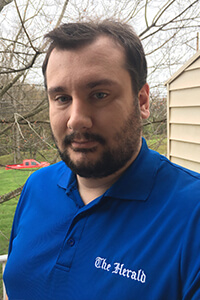 David Dye ’16 is a reporter at The (Sharon, Pa.) Herald. He covers a variety of municipal and general assignment beats for the Herald.
“For someone who works in local news such as myself, covering the COVID-19 pandemic as the disease gradually made its way here was interesting, to say the least. First, there were stories about the pandemic's effects overseas, then it came to the U.S. Being a reporter with a local newspaper, I was initially only able to localize the pandemic by talking to state health officials about how Pennsylvania overall could be affected—but eventually, I was talking with people from our own county and municipalities about how we would handle the pandemic.
Like a lot of other people during this pandemic, I'm was working from home, conducting interviews either online or over the phone. On one hand, technology has always been a part of the job, so this was not a huge change to the actual work itself; but on the other hand, it’s always preferable to speak with someone face-to-face, getting a chance to have conversations with people and to actually be out in the community when possible. And like any job you enjoy, it’s nice to be in the newsroom to be with the coworkers you’ve been working alongside for years.
Unfortunately, the pandemic affects a lot of stories during this time, from events at local schools that have been planned for months being canceled or businesses having to close their doors.
But life does go on, and there is good news out there—from local school officials finding ways to give their seniors some final recognition to local restaurants giving each other shout-outs online.
It may take a while, but the pandemic will end, and I look forward to reporting on reopened businesses, schools and people taking advantage of going outside when it does.”



 Webmail
 Campus Offices
 Directory
 Schedule an Event
 Maintenance Issue
 Spectrum U
 IT Support
 Academic Catalog
 Academic Resources
 Accessibility
 Attend & Assist
 Buy Books
 Calendar
 Campus Map
 Handshake
 Course List
 Library
 The Learning Commons
 Moodle
 Newsroom
 Public Safety
 Self Service
 Solution Center
 Pay My Bill
 Thiel Gear
 Tomcats Care
 Wellness Center